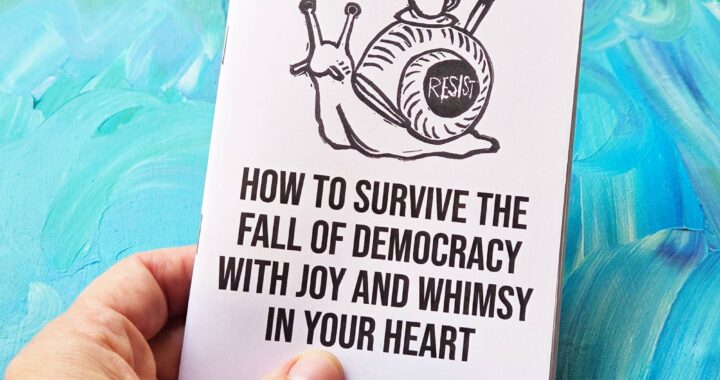
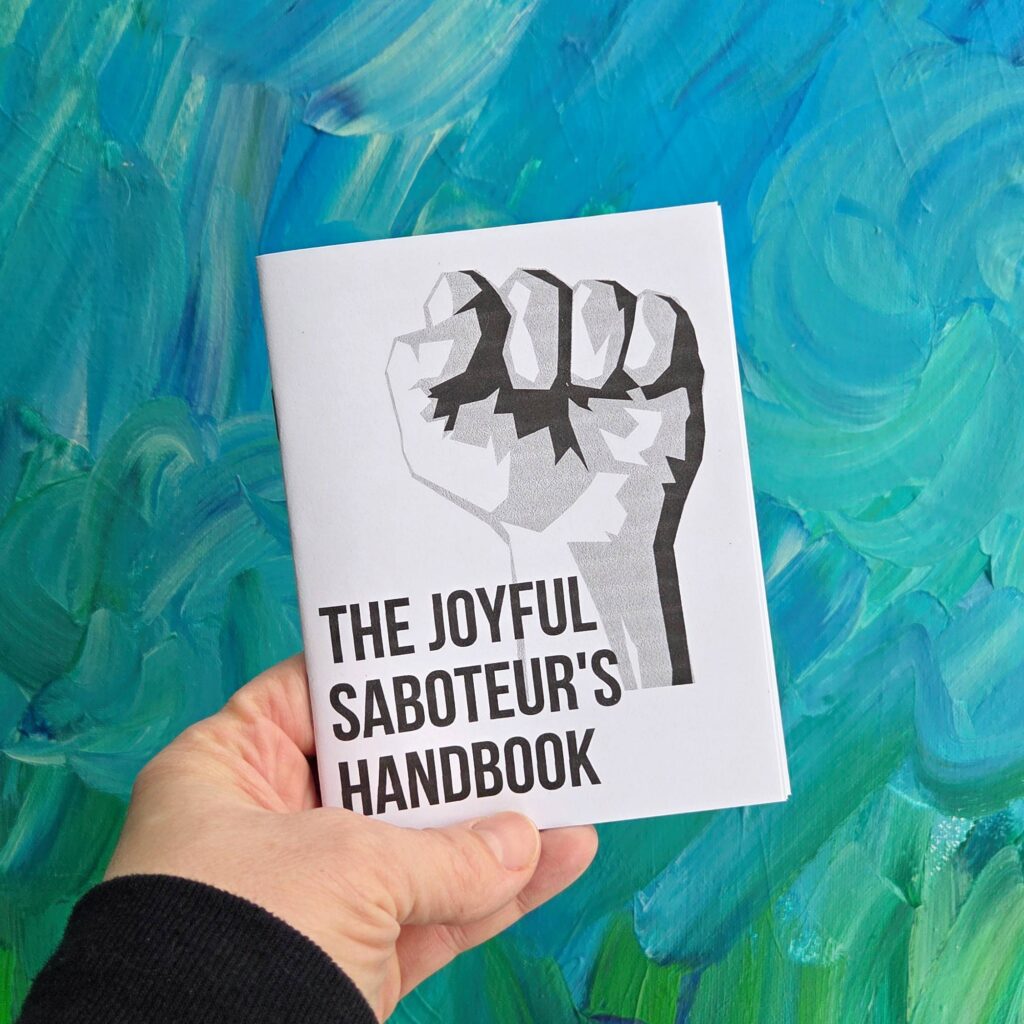
The Joyful Saboteur’s Handbook is the follow-up zine to How to Survive the Fall of Democracy with Joy and Whimsy in Your Heart. The first zine focused on staying human in unprecedented times. This one focuses on real life acts of resistance that people have used to challenge authority.
Inside you’ll find real examples of people using humor, art, music, ritual, and everyday acts of care to push back against authoritarian power. There are short historical stories, an interview about “guerrilla generosity,” reflections on women’s invisible labor in movements, ideas for using art in public spaces, a loud resistance playlist, and practical reminders about safety and ethics.
This zine looks at what happens when people laugh in court instead of shrinking. Or when they sing in jail, or dance in the street. When people cook, sew, print flyers, gather neighbors, and show up in a multitude of ways.
This zine doesn’t encourage illegal activity or harm. It explores how small, persistent actions can interrupt fear and isolation.
If you are burned out on outrage but not ready to give up, this zine offers examples of resistance that are creative, accessible, and found in real life.
Printed and assembled by hand.
For Further Reading:
- iceout.org is a website for keeping track of and reporting ICE activity
- https://beautifultrouble.org/
- Seven reasons why hosting a silly little potluck (or game night, or porch hang, or book club, or group hike) is essential to defeating fascism
Sources & More Information
Cover Image by OpenClipart-Vectors from Pixabay
An Interview with Missy B. and her Guerilla Generosity
I really really didn’t have a lot of space to add this interview! So here is the whole text. What’s in the zine is a tiny fraction.
Why do you think joy and play are important in resisting oppression?
I love this question! When you have a totalitarian regime in power, they are all about promoting and inspiring fear and hate and negativity. So, just the very act of being joyful and playful is a form of resistance. And in modeling that behavior the hope is that the joy and play are contagious and more people will turn away from the fear and the hate and the negativity.
How would you describe the kind of resistance you practice?
Years ago I came across a term that really summed up the way I practice resistance. That term is Guerrilla Generosity, and if memory serves it was something that started in England a few years back. Essentially, it is committing random acts of kindness and striving to help others. It embodies the guerrilla aspect in that instead of asking for permission to do something, I just go and do it. There’s often a lot of “red tape” when it comes to setting up events or programs to help others. I think that’s a lot of bullshit. So, for example, when I encountered teenager who was homeless and was asking about resources and where they could find warm clothes and a warm place to stay, I decided to just start gathering warm winter clothing items and set up one weekend in November to give those items out to people for free. I called it the Winter is Coming project. I also saw an article about free little pantries and decided to set some up around town so that people who had much could provide non-perishable food items and toiletries for those who had little. I want people to understand that it’s easy to help others, and you don’t necessarily need to go through what they call proper channels to do this kind of thing. Instead, you see a need and then you work to fill that need. I always say that it’s better to apologize later than to ask permission, especially when it’s about helping others.
After the current administration came into power, I had a lot of rage that I needed to direct in a positive way. Not to say there weren’t a few freezer spells involved, but because I felt helpless at that point, I decided to get involved in local politics and get new people onto the city council who were aligned with the vision of progress, transparency, and honesty. I can’t even vote in the city, but I felt so strongly about getting rid of the misogynistic, that returning mayor and his boy’s club that I decided to get involved. I even became the campaign chairperson for the new group of people and got out of my comfort zone by creating and hosting a town hall event that went very well. Ultimately, the misogynistic mayor never even appeared on the ballot because we dominated. So just that little redirection of my rage helped bring about positive change. Along with that, I also decided to try and open some minds. To do that, I decided to start placing copies of George Orwell’s 1984 and Margaret Atwood’s The Handmaid’s Tale in our local city park. My hope was that someone would stumble upon them, see the note that I left that said essentially “Important. Read, question, and think”. I still don’t know who picks up those copies or where they end up but my hope is that someone started to read and then started to question what’s happening and maybe, just maybe they opened their mind a bit more.
What first inspired you to use humor, play, or joy as part of your resistance?
I have always been someone who uses humor to diffuse tense situations, so it just seemed natural to me. Also, I recognize that there is such amazing power in positivity and play and joy. Laughter is a language we all share so even if we don’t necessarily understand one another if we can laugh together, we’ve broken the ice so to speak. What made me or inspired me to get more involved in using joy and play as part of the resistance was encountering a teenage boy at the local farmer’s market who didn’t have anywhere to go or anything to eat. I also [think] that helping others is a wonderful expression of joy, because the person receiving feels joy as does the person who is providing.
Can you share a moment when your approach felt especially powerful or effective?
A couple of years ago I decided to take what money I had to buy and fill some backpacks to live in the city park for kids who maybe didn’t have the resources to get school supplies before the start of the new school year. I bought colorful bright backpack and filled them with pencils and erasers and crayons and rulers. I had so much fun putting these together. Just doing something like that brought me a lot of joy, so I knew that putting those out there for kids to discover would bring them joy as well. I dropped the backpacks off in city park and then went and ran some other errands. About 30 minutes later, I was driving past the park and I saw a little girl on the steps of a church across from the park with two of the backpacks. She was sitting on the steps going through what was in the backpacks, and she had a huge smile on her face. That was a magical moment for me!
What do you hope people feel or think when they encounter your acts of resistance? My greatest hope is that my acts of resistance are contagious and that others will start to practice Guerrilla Generosity.
How do you decide where or when to act?
This is a really good question. What tends to happen is that I’ll notice something that needs to be done or someone who needs help and that will motivate me to do something to address it. For example, I live in a pretty rural area, on occasion there will be someone who is homeless who is on a corner holding a sign asking for help. When that happens, I will go up and introduce myself and ask their name. I will see what it is they need, and then I will give them money if I have it or offer them information about where they might find resources, etc.
Do you usually work alone, or is your resistance more collective?
I tend to work alone but my husband always has my back. He has helped me haul food and clothing to various locations. He listens to me when I rant about situations that are unfair or when I need to vent about the way the world is at present.
How have people responded to your acts of resistance — both supporters and opponents?
When I started to do the winter clothing collection and distribution and what I call Blessing Boxes where people could access food and toiletries, there were many people who were extremely generous. I don’t have a lot of room since we live in a tiny little cabin in the middle of the woods, so the church across from the city park allowed me to use their basement to store and sort the collected winter items. I did have some people say things like well what if somebody who doesn’t need those items takes them. I have always said that as long as at least one person gets something they need, I don’t worry too much about that. Plus, I’m a firm believer in karma, so if someone is taking things they don’t need then I figure the universe will sort that out at some point.
Have you ever had to rethink or adapt your approach after something didn’t go as planned?
Once I took a couple of chairs and a sign to the city park that said Stop and Have a Chat. I had been reading about how loneliness was becoming an epidemic and thought that I would just set up in the park and see if anyone who was feeling lonely or stopped by to talk. I had one lady come by to chat for a few minutes which was nice. Then I had one gentleman who was walking through the park come by and ask about what I was doing and we ended up having a nice conversation, but I was really hoping that more people would stop and chat. So it didn’t go as well as I would have liked, but it was a start, and I plan on doing it again.
What advice would you give to someone who wants to start practicing resistance in a playful way?
My advice is to take a look at the world around you and see what needs to be done. That is the first step. Then, take all the joy and love in your heart and put it towards filling those needs. What are we here for if not to help one another? Take what you have and share it. Bring your light and your joy into the world so that you inspire others to do the same.
The Quiet Labor of Resistance
Craddock, Emma. 2019. “Doing ‘Enough’ of the ‘Right’ Thing: Gendered Dimensions of Activism.” Gender, Place & Culture 26 (12): 1650–1667.
Grady, Constance. 2018. “The Waves of Feminism, and Why People Keep Fighting over Them, Explained.” Vox, March 20, 2018.
Minkoff-Zern, Laura-Anne, and Teresa Mares. 2025. “Reproductive Labor, Gender, and Food Work in the Home.” Journal of Agriculture, Food Systems, and Community Development.
Orleck, Annelise. 2014. Rethinking American Women’s Activism: Women’s Movements for Redistributive and Social Justice. New York: Routledge.
Ozkazanc-Pan, Banu. 2019. “On Agency and Empowerment in a #MeToo World.” Gender, Work & Organization 26 (9): 1212–1220. https://doi.org/10.1111/gwao.12311.
Platt, Lucinda. 2019. Understanding Inequalities: Stratification and Difference. 2nd ed. Cambridge: Polity Press.
Tools of the Joyful Saboteuer
Images by OpenClipart-Vectors from Pixabay
OpenClipart-Vectors from Pixabay
A Lemay from Pixabay
Ritual as Obstruction
“Walk for Peace.” Wikipedia article, updated 2026.
Leah Lemm, “Jingle dress dancers hold healing ceremonies in Minneapolis,” MPR News, Feb. 1 2026.
Q&A: Jingle Dress Dancer Answered Call to Ceremony in Face of ICE Violence – Native News Online
Examples of Joyful Sabotage
Dada Artists, Zurich (World War I) – Source: https://www.tate.org.uk/research/tate-papers/13/behold-the-buffoon-dada-nietzsche-ecce-homo-and-the-sublime
Orange Alternative – Source: Kenney, P. 2002. A Carnival of Revolution: Central Europe 1989. Princeton University Press.
British Suffragists Laughing in Court (early 1900s) – Source: Purvis, J. 2000. Emmeline Pankhurst: A Biography. Routledge.
Clown Brigades, Global (1990s–2000s) – Source: Bogad, L. M. 2016. Tactical Performance: The Theory and Practice of Serious Play. Routledge.
The Singing Revolution, Estonia (1987–1991) – Source: Smith, D. J. 1997. The Baltic States. Routledge.
Civil Rights Freedom Songs, U.S. (1950s–1960s) – Source: Reagon, B. J. 1997. If You Don’t Go, Don’t Hinder Me. University of Illinois Press.
Carnival Against Capitalism (1999) – Source: Notes From Nowhere Collective. 2003. We Are Everywhere. Verso.
More things I discovered since this zine has been published: